Wednesday, January 28, 2009

eecycle works eebrake

This is a review of the eecycle works eebrake
These are Craig Edward's latest creation, the eebrake. Craig was originally known for his "Sweet Wings" cranks that came out during the early '90's. They were superlight cro-mo cranks that featured an integrated bb design that has since been copied (incidentally, he is also working on a new and lighter crank due later this year). His manufacturing and design talent can now be found in these stunning new brakes.

* Cost: $519 MSRP (without brake pads)
* Unique industrial design
* Exclusiveness; different
* Excellent performance
* Made in the USA
* Light weight: 162 grams (pair) without pads; 182 grams with Dura Ace pads
* Very easy to change out brake pads (for those that have alloy trainers and carbon racers)
* Adjustable reach to fit many bikes

Installation

Unfortunately, the brakes didn't come with pads so I purchased a Dura Ace set. Installing the pads was incredibly easy; the holders have wide tolerances that make it easy to slip the new pad in--which you do at an angle. You then pivot the rear section down and snap them in to place. The holders have a "no-screw" feature that makes it easy to install or replace. Yet the pads definitely feel secure. These brakes would be ideal for folks that like to switch between training wheels with alloy braking surfaces and carbon rims for racing.
The rest of the documentation was a bit daunting but proved easy once the front set was installed. The major hurdle is you need to remove a retaining nut to free up a the bolt that fits into the fork or rear stay. The retaining bolt features an eccentric design that allows you to pivot the bolt up or down, extending the "drop" of the brake if needed. It also allows fine-tuning for out of true wheels. Luckily I didn't have to remove too many links from my Nokon cables (PIA alert) to fit these brakes in place of my Zero Gravity Ti's.

Dialing in the brake pads was on par with any other brake set, and the cable length was easily adjusted (though different) with the large barrel adjuster.

Weight
Thanks to Zero Gravity, who really disrupted the space about 5 years ago, there is now a lot of innovation and choice with brakes, ranging from the ultra expensive to some great stand-byes.

On my scale, the eebrakes weighed 164 grams without pads and 184 grams with. For comparison, my Zero Gravity Ti's were 2 grams heavier. Below are actual weights for these two along with MSRPs and claimed weights (pads included) for other brakes that folks may be considering. (Note: Zero Gravity produces excellent products and has fantastic customer service. I fully support their products. Additionally, I own Zero Gravity Ti, Negative Gravity Ti, and Mavic SSC brakes).

Brake MSRP Weight $/gram
* AX-Lightness Orion $1,600 144 $11.11
* M5 $ 740 202 $ 3.66
* eebrake $ 519 184 $ 2.82
* Zero Gravity Ti $ 430 186 $ 2.31
* Negative Gravity Ti $ 400 230 $ 1.74
* Dura Ace 7900 $ 440 284 $ 1.55
* SRAM Red $ 295 265 $ 1.11
* Campy Record Skeleton $ 300 275 $ 1.09
* Dura Ace 7800 $ 235 314 $ 0.75
* Mavic SSC $ 190 310 $ 0.61

As you can see, the eebrakes are toward the upper end of $/gram. This being said, Shimano 7900 is certainly raising the price bar on "mass produced" brakes. And if you are paying $440 for Dura Ace, suddenly $100 more doesn't seem so far out of the question.

Performance
I think the closest comparison to the eebrake is the Zero Gravity Ti. Zero Gravs have stood the test of time with great industrial design, incredible light weight, and very good stopping performance. How would the eebrake compare?
From my testing, the eebrake provides superior braking performance (much stronger braking), good modulation, and a slight decrease in weight. They also have a much stronger return spring; the return spring helps "snap" the brake lever back into place and creates a very stable and secure feel. This feature would be very useful with TT brake levers that rely on cable tension versus return spring. And, as stated, braking performance was excellent.

What's truly amazing, though, is that despite it's 5-pivot design, there was no flex or "slop" in the brake. I find this incredible because each pivot should introduce some degree of "play". Yet there was none with this remarkable brake set.

Design
These brakes do their functional job extremely well; I don't think there really is a set of better stoppers out there. This being said, this brake isn't for everyone. They are very expensive. And they have a polarizing look; some may think it's ugly, others might think they are beautiful. As my friend said, "They aren't brakes. They are artwork"--I couldn't agree more.
On my carbon Cervelo R3, I found these brakes to look a bit out of place; something so classy and mechanical on a modern black carbon frame. Where these brakes would truly be at home is on a classic lightweight steel or Ti frame--Schwinn Paramount, Indy Fab, Colnago, Moots, or Cervelo Prodigy. It would be outstanding to see these calipers on the latest Reynolds 953 steel frames.

Summary
These brakes offer outstanding performance, a unique look, and exclusivity--but at a price.
If you are lucky enough to afford components in this price range, the eebrake is a compelling choice.

Wednesday, January 7, 2009

Fizik Antares Saddle


Fizik Antares Saddle

  • Cost: $199 MSRP

  • Comfortable yet very light weight

  • Natural Leather Seat Cover

  • Made in Italy

  • ICS bag compatible

  • Weight: Claimed 175 grams. Actual: 177.


This is a review of the Fizik's latest saddle, the Antares.
It's supposed to be the "third dimension" between Fizik's excellent Airone and Aliante. I'm not sure what the third dimension really means but what I discovered that it's really a comfortable alternative to minimalist saddles like the Selle Italia SLR.

I decided to compare the Antares not only to it's brethren but also to the
Selle Italia SLR. Here's how they measured up:


  • Antares: Width: 140mm, Length: 275mm, 177 Grams

  • Aliante: Width: 135mm, Length: 265mm, 215 Grams

  • Airione: Width: 128mm, Length: 302mm, 241 Grams

  • SLR: Width: 125mm, Length: 275mm, 135 Grams


Comparing the saddles


My first experience with Fizik saddles was the Airone. It's a great
looking saddle that is much longer (25mm more than the Antares and SLR) than
most saddles. I suppose this is to give you more freedom to move for/aft for
spinning or pushing big gear. But despite it being the narrowest of the four--and with it's built in "wing flex", I've found that this saddle hits in the wrong places and is actually a bit of a disappointment; I tend to "get numb" when riding this saddle, especially when on the trainer. Lastly, the Airone isn't ICS compatible. ICS is Fizik's built-in adapter that allows you to clip in Fizik brand accessories like saddle bags and lights. The other two models are
ICS compatible.

I purchased the Aliante about 9 months ago -- and found it to be the
absolutely most comfortable saddle I've ever tried. I believe the secret to the
Aliante's comfort is its suspension; the seat is suspended like a hammock.
Notice the gold mesh in the picture above; it's essentially a fabric weave that
allows floatation. The Airone and Antares have more traditional carbon shells
(as does the SLR). The Aliante is supremely comfortable whether pushed back
against the upraised back or pushed forward on the padded nose. With the Aliante, it feels like you sit "in" the saddle versus being perched "on" it. I can't say enough great things about the Aliante.

So how would the Antares fair? Oddly, the Antares is the widest of the
bunch and slightly longer than the Aliante. It has a much slimmer profile and
weighs a very respectable 177 grams (there is a carbon railed version with a
claimed weight of 145 grams that costs $30 more). At first look, I thought it
would mimic the feel of the Selle Italia SLR: ridable but not exactly
comfortable. Amazingly, the Antares was fantastic. Despite it's slim profile,
the padding is dense yet comfortable and it's width fully supports your sit
bones. As with the Aliante, it was comfortable sitting toward the rear yet still
offered enough padding in the nose for spinning up hills. The saddle was very
comfortable over a 40+ mile ride, something I could never say about the Selle
Italia SLR. I'm looking forward to trying this on my tri bike--as I the nose has
more extension than the Aliante while also offering enough cushion for forward
position aero-bar riding.

Overall, I still think the Aliante is the most comfortable road bike
saddle--ever. The Antares is my second favorite saddle -- a lightweight
alternative for the weight weenie crowd that might even prove to be a good
solution for triathlons and time trials. I'll update this review when I've spent
some time on the tri bike with it.

Tuesday, September 30, 2008

SRAM Red 5-piece component upgrade

Purchased 9/23/08
This is a review of the SRAM Red 5-piece upgrade. I've been sticking with Shimano 9-speed Dura Ace because I have 4 road bikes that I'm always switching components on. Plus, I haven't really seen a compelling reason to switch my Dura Ace Octalink BB (175 grams) and FSA Superlight Cranks (522 grams) for the new-tech outboard bearing cranks; they aren't significantly lighter and are a lot more expensive. However, I recently bought a new used Cervelo R3 and the weight-weenie bug struck hard. Plus, the 11-26 SRAM cogset seems like a great upgrade that lends a huge range of flexibility. Shimano offers only 11-23 or 12-25. And the Red component group is rumored to be much lighter. It was time to upgrade to 10 speed. Plus I pooled my 42nd birthday funds to afford the upgrade.


Cost/Benefit


Below is pricing and weights from the Excel Sports web site (as of 9/29/08).  Last year's Dura Ace and Campy Record 10-speed currently have steep discounts while the new Dura Ace and Campy 11-speed have big premiums as they are being introduced. SRAM Red is in between; more expensive than the 2008 models but less expensive than the 2009 models. But lighter than all. Kudos to SRAM for forcing the competition to go back to the drawing board. This being said, the original Dura Ace 9 Speed has certainly stood the test of time and is a remarkable value for price and weight.


Weights


The SRAM shifters came with the shift cables installed. I didn't want to remove them so weighed them together, they came in at 323 grams, 53 more than the
claimed naked weight. But still far less than the 485 for D/A 9 Speed. Campy and SRAM shifters are a lot lighter than D/A, regardless of the model. Also, the cassette, chain, and rear derailleur were largely on track though the Front Derailleur was way off. I chose to compare "claimed" weight according to Excel Sports to provide the most consistent baseline.


Regarding costs, it is ABSURD to think that shifters are now over $500. And the new Dura Ace at SEVEN HUNDRED DOLLARS should be considered criminal. $300+ for a rear derailleur is also getting out of hand. As 2008 draws to a close, deals can be found on last year's models so keep an eye out.


Component Highlights - Shifters


In a few years, I think the cycling community will look at Shimano shifters
that have the derailleur cables coming out at 90 angles as totally primitive. SRAM and Campy offer cable routing that follows the taper of the bar. SRAM even offers the ability to route the derailleur cables either inboard or outboard. How smart is this? Having both cables route on the inside provides a seamless transition along the handlebar-awesome. Ironically, I did initially miss the "safety blanket" feel of the cable jutting out as a hand hold. But I'll get over this. As a side note, I believe Campy has offered multiple cable positions for some time.

Another cool feature is the SRAM Red shifters/brake levers also offer adjustable reach. But I chose to leave the reach in the default position.


How do they work? The shifters are very fast and have a nice, positive and substantial feel. The front derailleur has a bit of a long throw to get into the big ring, but it is not objectionable. Shifting the rear down from the 26 to the 23 was a bit tricky; it will take some time to master the small step down versus clanking all the way to the 21. But overall, not a traumatic change from Shimano. And as I get used to it, I am sure it will become second nature. 


Component Highlights - Derailleurs


The derailleur set up was just plain finicky. SRAM provides terrible documentation, and the group I got from Colorado Cyclist had almost no packaging. I resorted to the web site's downloadable PDF for "dealers" . This proved to be helpful but not perfect.

Rear derailleur: What's cool-the angle between the cable exit and shifter comes out at a sharp angle which locks the cable; it's easier to adjust cable tension than with Shimano. But it was very difficult to set the b-tension screw
correctly. Unfortunately, perhaps because of the wide gear range provided by the 11-26, it wasn't possible to dial out chain rub in the 11 and 12 tooth cog while riding in the front small ring. There is significant chain rub in either gear. Additionally, the manual calls for maintenance/relube of the ceramic bearings every 100 miles. I have to say that that is a bit of a pain in the butt.


Front derailleur. The front derailleur provides trimming in the big ring; if you are mid-ring in back, you can semi-shift the FD to drop down a bit. This gives more flexibility in the middle gears and even allows cross-chaining without rub. This being said, in the 53x11, the chain would rub and slip. Adding more travel
to the big ring simply meant over-shifts with the chain dropping off. I think I have to visit my LBS for fine tuning of the front and rear.


Component Highlights - Cogset and Chain
The cogset really steals the show. It is machined from one piece of steel and is hollowed out inside! This is pretty ingenious. More amazing, I love the 11-26 combo and wonder why no one else thought of this. The cogset has a third piece-a sleeve that goes over the cassette body. This proved to be problematic as the sleeve wouldn't fit over the cassette body. I exercised restraint (ie, didn't hammer it in to place) and had my LBS, Calmar Cycles, do the final install. This involved using a Dremel tool to file down the detents in the freewheel. Please note, if you are an SRAM Red owner and don't have the sleeve--get one! The customer care rep at Easton (I have Easton Ascent II's) strongly suggested using it and warned of death/serious injury. SRAM also says it keeps water out. The cogs also feature flat spots that are supposed to make the chain pickup faster. Not sure if this works, but it seemed very quick to me. The finish is also a nice and bright. The chain, 1090-r, features hollowed side plates and weighs in at very light 260 grams. Not bad. The chain/cogset combo is a bit noisier than Shimano with a louder, more mechanical "whirring" sound.


The finished product!


All in all, the SRAM upgrade yielded wider gearing (11-26), 10-speed Shimano capability (you can use a Shimano cogset), as well as 8 ounces of weight savings. I also put on lighter cranks (-53 grams) and skewers (-23 grams) netting a loss of 270 grams/ 9.6 ounces.


Here's the finished product at 14pounds, 7 oz or 6560 grams.


Sunday, March 23, 2008

Amazing Sheesh-chewing off too much


Gary, Larry, and I were off on another Porta-Bote adventure at Anderson Resevoir, happily in search of crappie and large mouth bass. We noticed some splashing in the shallows and headed over. There was a large bass essentially paralyzed on the surface with a crappie jammed in it's mouth! I was able to grab the bass and lift it in to the boat. Using pliers, I pulled the crappie out of his mouth; the crappie was at least 8 inches long (unfortunately, pulled off part of his tail too...) but he was still alive. I let the crappie go then we weighed the bass; 3 pounds and 18 inches with a big fat belly. He looked blind in one eye--maybe that's why he bit off more than he could chew. Amazingly, it swam off just fine.

Amazing Sheesh!

Yo-Zuri Floating Crystal Minnow


This lure is amazing! Caught 3 crappie and 2 bass at Anderson Resevoir in early spring (March 22 '08) with my Gary Chan and Larry Boyle.

You can buy them at Cabelas for $7-8. Expensive but worth it.

Wednesday, November 28, 2007

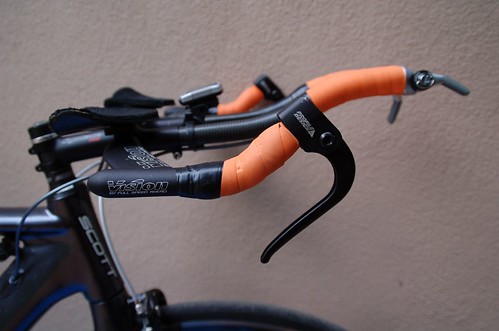
Triathlon gear: Vision Base Bars


These Vision Base Bars from Full Speed Ahead are amazing. They are fairly light (around 230 grams), extremely stiff, and offer an excellent "in the drops" hand position. I am a fairly cautious descender, but these bars allow a very secure hand grip that inspires confidence. The flats of the bars allow a comfortable upright position. And while in the aero bars, the flat profile of the base bar allows easy transition from the aero extensions to the bar ends. I'm pairing these with Hed aerobars and it's a great combination.

The vision base bars are relatively cheap; around $100 for the alloy version. The carbon version is more expensive and only marginally lighter. In the San Francisco Bay Area you can get these from Front of the Pack which is where I got them.

Thursday, November 1, 2007

Dean Kamen's Prosthetic Arm

This is an incredible story and amazing technology that's come out of it. Dean Kamen is recently famous for the Segway scooter. This prosthetic arm is a much more impressive invention.